
DripVitals health guide
Microdosing Semaglutide Chart: Every Dose Below 0.25 mg

Microdosing semaglutide means taking a weekly dose below 0.25 mg, the lowest approved starting dose. Most microdosing charts use amounts from 0.05 mg to 0.2 mg once a week, raised a little about every four weeks. There is no official microdosing chart; the one below lists the doses in use, the syringe units for each, and how a clinician might space them.
Last updated October 18, 2026

Key takeaways
- Microdosing semaglutide means a weekly dose under 0.25 mg, most often between 0.05 mg and 0.2 mg.
- No official microdosing chart exists. The doses and schedule here describe common practice, not a plan to follow without a prescriber.
- At these amounts the syringe volumes are tiny: 0.1 mg is 4 units from a 2.5 mg/mL vial and only 2 units from a 5 mg/mL vial.
- Semaglutide's boxed warning and contraindications apply at every dose, however small.
Semaglutide microdose chart: every dose below 0.25 mg
Any weekly amount under 0.25 mg counts as a microdose. The chart shows the amounts that appear in most microdosing schedules, with the matching volume on a U-100 insulin syringe at two concentrations commonly reported for compounded semaglutide. Concentrations vary between pharmacies, so the label on your own vial decides your numbers.
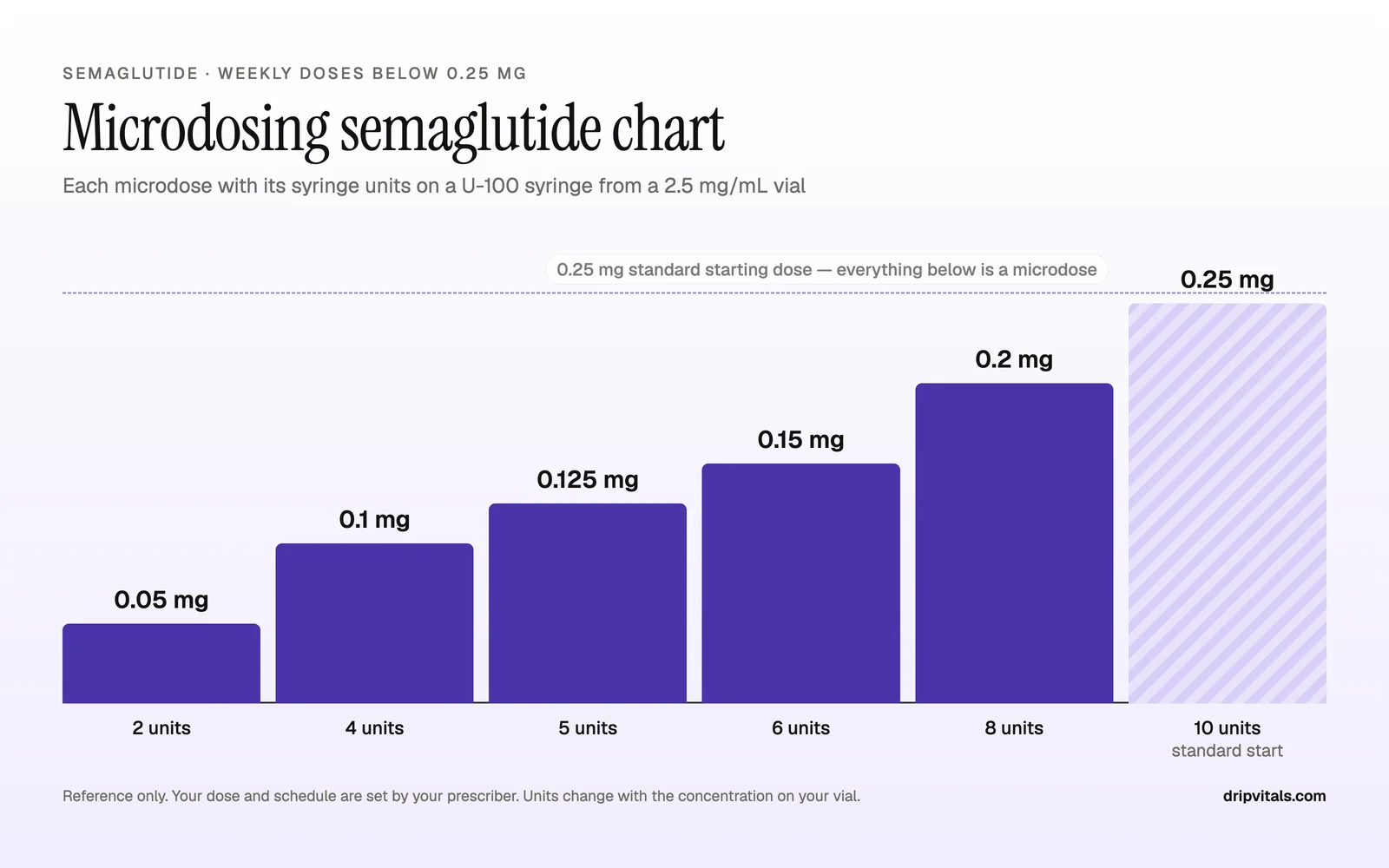
| Weekly dose | Share of the 0.25 mg starting dose | Units at 2.5 mg/mL | Units at 5 mg/mL | Where it usually fits |
|---|---|---|---|---|
| 0.05 mg | 20% | 2 units | 1 units | The smallest step most charts use |
| 0.1 mg | 40% | 4 units | 2 units | A common first microdose |
| 0.125 mg | 50% | 5 units | 2.5 units | Half the standard starting dose |
| 0.15 mg | 60% | 6 units | 3 units | A common middle step |
| 0.2 mg | 80% | 8 units | 4 units | The top of most microdosing schedules |
| 0.25 mg | 100% | 10 units | 5 units | Standard starting dose (not a microdose) |
Some charts go lower still, to 0.025 mg, which is a single unit at 2.5 mg/mL. Volumes that small are very hard to draw accurately, so a clinician who wants a dose in this range may ask the pharmacy for a weaker concentration rather than ask you to measure one or two units.
Sample microdosing semaglutide schedule, week by week
Semaglutide stays in the body a long time: its half-life is about a week, so it takes four to five weeks of weekly doses before the level evens out. That is why most microdosing schedules hold each step for about four weeks before deciding on the next one.
| Weeks | Weekly dose | Units at 2.5 mg/mL | What your clinician checks |
|---|---|---|---|
| Weeks 1–4 | 0.05 mg | 2 units | Nausea, fullness and any injection-site reaction |
| Weeks 5–8 | 0.1 mg | 4 units | Whether stomach symptoms settled before the next step |
| Weeks 9–12 | 0.15 mg | 6 units | Appetite, hydration and bowel habits |
| Weeks 13–16 | 0.2 mg | 8 units | Whether to stay here or keep going |
| Week 17 onward | Stay on a microdose, or move to 0.25 mg | 8–10 units | Your response and goals; the clinician decides |
A clinician may also start at 0.1 mg for someone without past GLP-1 side effects, or hold a step for several extra weeks. If symptoms are still there at the end of a step, the usual answer is to wait, not to climb.
Microdosing vs. a low standard semaglutide dose
People sometimes call it microdosing when they simply stay on a low standard dose, such as 0.25 mg or 0.5 mg, instead of climbing to the 2.4 mg maintenance dose. That is a different thing: those amounts sit inside the standard schedule. Microdosing goes below its first step.
| At a glance | Microdosing | Staying on a low standard dose | Full standard schedule |
|---|---|---|---|
| Weekly dose | 0.05–0.2 mg | 0.25 or 0.5 mg, held | 0.25 mg rising to 2.4 mg |
| Units at 2.5 mg/mL | 2–8 units | 10–20 units | 10 units and up |
| Time on each step | Usually about 4 weeks | As long as it keeps working | At least 4 weeks |
| Basis | No standard protocol; set case by case | A prescriber's decision within the schedule | The approved prescribing information |
For every step of the standard schedule, see the semaglutide dosing chart.
How many units is a semaglutide microdose?
Your prescription gives the dose in milligrams; the syringe is marked in units, where 100 units fill 1 mL. To convert:
units = (dose in mg ÷ concentration in mg/mL) × 100
Example: 0.15 mg from a 2.5 mg/mL vial is 0.15 ÷ 2.5 × 100 = 6 units. From a 5 mg/mL vial the same dose is 3 units. The milligrams are the dose; the units only describe how much liquid to draw.
- 0.3 mL syringe (30 units): often marked in half units, the practical choice for doses this small.
- 0.5 mL syringe (50 units): marked in single units, which is coarse for a 2-unit dose.
- 1 mL syringe (100 units): usually marked every 2 units, too coarse for microdoses.
The FDA has warned about overdoses with compounded semaglutide when people mixed up units, milliliters and milligrams. Read the concentration on each new vial, and ask the pharmacist to confirm your first draw.
Reasons people microdose semaglutide
Microdosing semaglutide spread through 2024 and 2025, when compounded vials made doses under 0.25 mg possible and low-dose routines were widely shared online. The usual reasons:
- A rough start. Nausea, fullness, constipation and diarrhea are the side effects people report most. A smaller first step aims to soften that, though nobody has shown it does below 0.25 mg.
- Sensitivity. People with a lower body weight, or who reacted strongly to a GLP-1 medicine in the past, may be started lower.
- Maintenance. Some patients and clinicians step the dose down after a goal is reached, rather than stopping.
- Cost. A vial lasts longer when each weekly dose is smaller.
As of October 2026 there is no controlled research on semaglutide doses below 0.25 mg. A benefit is possible, but it is not established.
Side effects and risks a microdosing chart doesn't show
- The boxed warning applies. Semaglutide carries a boxed warning regarding thyroid C-cell tumors observed in rodents, and is contraindicated in people with a personal or family history of medullary thyroid carcinoma or Multiple Endocrine Neoplasia syndrome type 2. A smaller dose does not change that.
- Serious adverse events remain possible, including pancreatitis, gallbladder disease, kidney injury from dehydration, diabetic retinopathy complications and hypersensitivity reactions.
- Measuring errors matter more. At 2 units, misreading a single line doubles or halves the dose.
- Surgery and sedation. GLP-1 medicines slow stomach emptying, and their labeling warns about aspiration during anesthesia. Tell your care team you take semaglutide before any procedure.
- Long-term effects are unknown. Years of low-dose use have not been studied.
- Compounded preparations are not FDA-approved. They are prepared by a licensed pharmacy to fill an individual prescription and are not reviewed by the FDA for safety, effectiveness, or quality before marketing.
Who shouldn't microdose semaglutide
Semaglutide is still semaglutide at a tenth of the starting dose. Don't take it at any dose if you:
- Have a personal or family history of medullary thyroid carcinoma or Multiple Endocrine Neoplasia syndrome type 2 (MEN 2)
- Have had a serious allergic reaction to semaglutide or any ingredient in the preparation
- Are pregnant or planning a pregnancy
- Already take another GLP-1 medicine
Mention any history of pancreatitis, gallbladder problems, kidney disease, diabetic eye disease, or severe stomach or bowel conditions to your clinician before starting.
When a clinician lowers a semaglutide dose
Adjusting a dose for one patient is routine medical care, and it is different from microdosing off a chart. A clinician may keep someone on 0.5 mg because it works, pause the climb while nausea settles, or step down after a goal is met. The difference is that the decision is made for you, recorded in your chart, and followed up by someone watching how you respond.
Microdosing semaglutide chart: frequently asked questions
What is microdosing semaglutide?
It means taking a weekly semaglutide dose below 0.25 mg, the lowest approved starting dose, usually somewhere from 0.05 mg to 0.2 mg. The approved labeling does not include any dose that low.
What is the lowest dose of semaglutide?
The lowest approved injectable dose is 0.25 mg once a week, and it is labeled as a starting dose rather than a treatment dose. Smaller amounts are only possible with a compounded preparation prescribed for you.
How many units is 0.1 mg of semaglutide?
From a 2.5 mg/mL vial, 0.1 mg is 4 units on a U-100 syringe. From a 5 mg/mL vial it is 2 units. Always use the concentration printed on your own vial: units = dose in mg ÷ concentration in mg/mL × 100.
How many units is 0.25 mg of semaglutide?
From a 2.5 mg/mL vial, 0.25 mg is 10 units. From a 5 mg/mL vial it is 5 units. That is the standard starting dose, not a microdose.
How long should you stay on each semaglutide microdose?
Usually about four weeks. Semaglutide's half-life is roughly a week, so it takes four to five weeks of weekly doses for the level to settle. Your clinician may keep you on a step longer if side effects haven't eased.
Is microdosing the same as staying on 0.25 mg or 0.5 mg?
No. Staying on 0.25 mg or 0.5 mg means holding a dose that is part of the standard schedule. Microdosing means going below 0.25 mg, which is outside the approved labeling.
Does microdosing semaglutide reduce side effects?
That is the hope, because stomach side effects tend to appear as the dose rises. It has not been shown for doses below 0.25 mg, and some people still feel nauseous on very small amounts.
Can you microdose semaglutide for maintenance?
Some clinicians lower the dose once a goal is reached instead of stopping treatment. Whether a smaller dose keeps weight off has not been established, and regain after lowering or stopping is common, so plan it with your clinician.
What should I do if I miss a microdose?
Follow your prescriber's instructions. Under the standard weight-management schedule, a missed dose is taken as soon as you remember if the next one is more than 2 days away; if it is less than 2 days away, skip it and keep your usual day. Never double up.
Is microdosing semaglutide safe?
Its safety has not been established. Semaglutide's boxed warning about thyroid C-cell tumors and its contraindications in people with a personal or family history of medullary thyroid carcinoma or MEN 2 apply at any dose, and pancreatitis, gallbladder disease and kidney injury from dehydration remain possible.
Do I need a prescription to microdose semaglutide?
Yes. Semaglutide is a prescription medicine at every dose, and doses below 0.25 mg have to be compounded for an individual prescription by a licensed pharmacy. Products sold online without a prescription, including so-called research peptides, are not made for human use.
What happens if I stop taking semaglutide?
Appetite usually returns and weight regain is common. Any dosing plan, including microdosing, should account for what happens when treatment ends.
Still have questions?
Talk to a clinician about the right dose for you
Dosing is a clinical decision, not a menu choice. Complete an online evaluation and a licensed clinician will review your history and determine whether treatment is appropriate — and if so, at what dose.
Start your evaluationNot everyone qualifies. Treatment is prescribed only when a licensed clinician determines it is appropriate.
 Medically reviewed
Medically Reviewed
Dr. Emmanuel Noel Cruz Tancinco, MD
Attending Physician · ABAARM · FAAMM · DABOM
Board-certified in obesity medicine and internal medicine, with practice focused on hormone optimization, metabolic medicine, and longevity-focused care — licensed in all 25 states we serve.
- Hormone Optimization
- Obesity & Metabolic Medicine
- Longevity-Focused Care
- Functional Medicine
Education & certifications (10)
- American Board of Anti-Aging and Regenerative Medicine (ABAARM)
- Anti-Aging Metabolic Medicine, American Academy of Anti-Aging Medicine
- American Board of Obesity Medicine (DABOM)
- American Board of Internal Medicine
- The Institute for Functional Medicine
- Bioidentical Hormone Replacement Therapy certified
- Peptide Certification / Member, International Peptide Society
- Integrative Gastroenterology, Endocrinology, Cardiology & Neurology Certification, The George Washington University School of Medicine and Health Sciences
- Member, The American Academy of Anti-Aging Medicine (A4M)
- Member, American College of Physicians
This page was reviewed for medical accuracy. Treatment decisions are made by a licensed provider after reviewing each patient’s medical history.