
DripVitals health guide
Microdosing Oral Semaglutide Chart: Daily Doses Below 1.5 mg

Microdosing oral semaglutide means taking a daily amount below 1.5 mg, the starting dose of the approved weight-management tablet. Unlike the weekly injection, the approved tablets can't be split, so smaller daily amounts only exist as compounded preparations. The chart below shows where those amounts sit against the starting tablet, and why a tablet milligram is not the same as an injection milligram.
Last updated October 19, 2026

Key takeaways
- The approved oral semaglutide tablet for weight management starts at 1.5 mg once a day and steps up every 30 days to 25 mg. Any daily amount below 1.5 mg is a microdose.
- The approved tablets must be swallowed whole, so they can't be cut into microdoses. Smaller amounts exist only as compounded preparations.
- A milligram swallowed is not a milligram injected. Oral and injection doses can't be swapped or compared number for number.
- Semaglutide's boxed warning and contraindications apply to tablets as much as to injections, at every dose.
Oral semaglutide microdose chart: daily amounts below 1.5 mg
The chart shows daily amounts below the 1.5 mg starting tablet in 0.25 mg steps, with each one as a share of that starting dose and as a weekly total. There is no published microdosing schedule for oral semaglutide, so read these as reference points, not as a recommended set of doses.
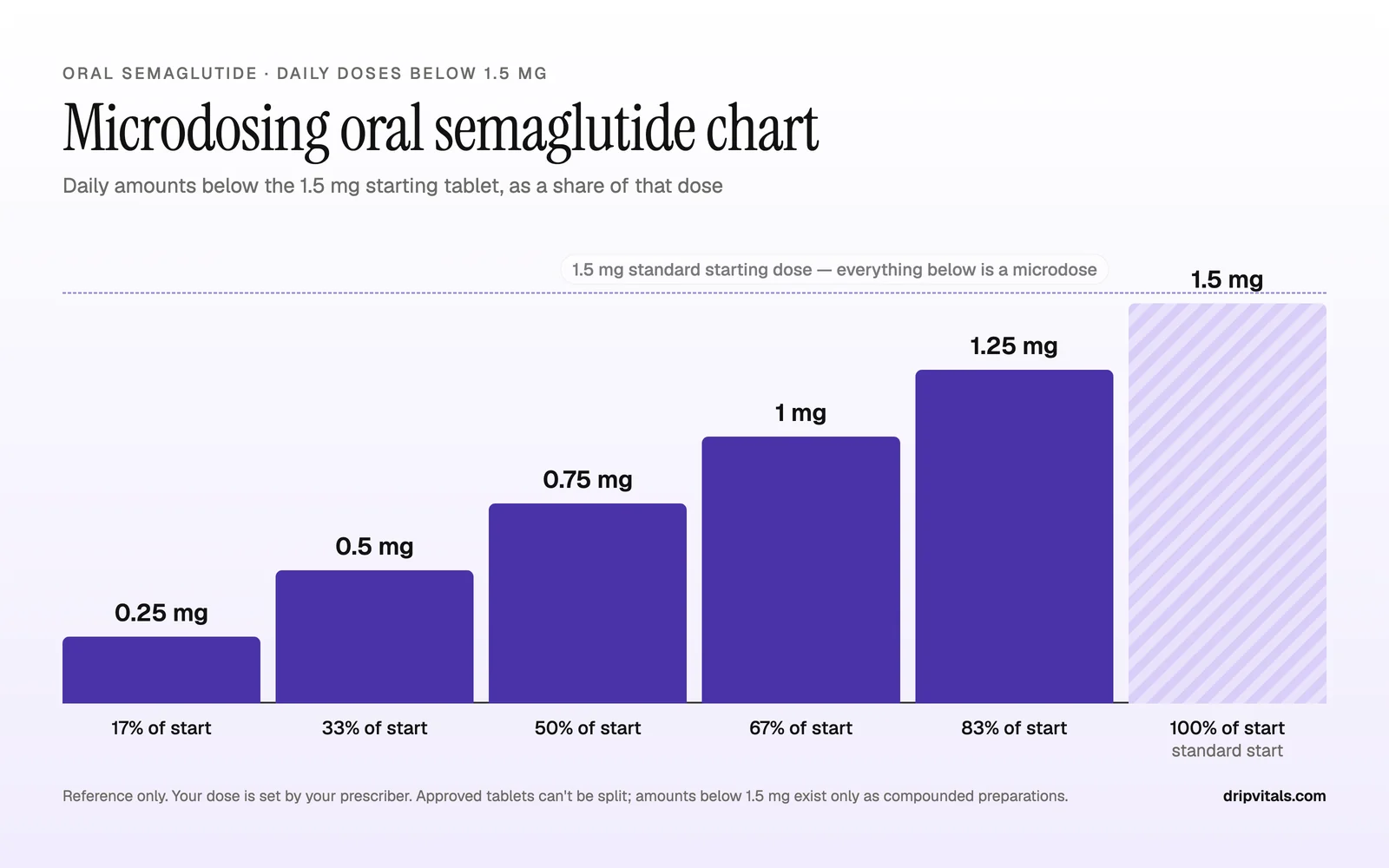
| Daily amount | Share of the 1.5 mg starting dose | In other words | Taken over a week |
|---|---|---|---|
| 0.25 mg | 17% | One-sixth of the starting tablet | 1.75 mg |
| 0.5 mg | 33% | One-third of the starting tablet | 3.5 mg |
| 0.75 mg | 50% | Half of the starting tablet | 5.25 mg |
| 1 mg | 67% | Two-thirds of the starting tablet | 7 mg |
| 1.25 mg | 83% | Five-sixths of the starting tablet | 8.75 mg |
| 1.5 mg | 100% | The starting tablet (not a microdose) | 10.5 mg |
The weekly totals look large next to injection doses. That is expected: only a small part of a swallowed dose reaches the bloodstream, which is why tablets are measured in milligrams per day and injections in fractions of a milligram per week.
With a compounded tablet, drop or dissolving film, the strength on the label is set by the pharmacy, and how much of it your body absorbs has not been established. That means a compounded 0.5 mg can't be assumed to equal half of an approved 1 mg tablet. Your prescriber and pharmacy label are the only reliable guide.
The approved oral semaglutide dosing schedule
The once-daily semaglutide tablet for weight management, approved in December 2025, follows a 30-day step pattern. Microdosing sits below its first row.
| Days | Daily dose | Stage |
|---|---|---|
| Days 1–30 | 1.5 mg | Starting dose, to let the body adjust |
| Days 31–60 | 4 mg | Step-up |
| Days 61–90 | 9 mg | Step-up |
| Day 91 onward | 25 mg | Maintenance dose |
If a step is not tolerated, the labeling allows the increase to be delayed. Tablets prescribed for type 2 diabetes follow their own schedule. For the weekly injection's schedule, see the semaglutide dosing chart.
Sample gentler start with a lower oral dose
When a clinician wants to begin below the starting tablet, the usual approach borrows the approved 30-day rhythm. Semaglutide has a half-life of about a week, so a month on each step gives the level in your body time to settle before the next decision.
| Days | Daily amount | What your clinician checks |
|---|---|---|
| Days 1–30 | 0.5 mg | Nausea, appetite and how the daily routine is going |
| Days 31–60 | 1 mg | Whether stomach symptoms settled before stepping up |
| Days 61–90 | 1.5 mg, or stay at 1 mg | Tolerance at the standard starting dose |
| Day 91 onward | The standard steps, or hold | Your response and goals; the clinician decides |
Because compounded strengths vary, a clinician may also simply hold you on the lowest available strength for longer, rather than adding steps.
Why you can't microdose the approved tablet
Oral semaglutide only works because of how the tablet is built and taken. The approved directions are strict:
- Swallow the tablet whole. Don't split, crush, chew or dissolve it.
- Take it first thing in the morning on an empty stomach, with no more than 4 oz of plain water.
- Wait at least 30 minutes before eating, drinking anything else, or taking other medicines by mouth.
Cutting a tablet in half doesn't reliably give you half a dose, and it can change how much is absorbed. That is why lower daily amounts come from compounded preparations made at that strength, not from splitting approved tablets.
Oral vs. injectable semaglutide microdosing
Both forms contain semaglutide, but their doses live on different scales. The starting tablet is 1.5 mg every day, about 10.5 mg a week, while the starting injection is 0.25 mg once a week. Both are simply starting doses. Never convert between them by milligrams; a switch from one form to the other is planned by your clinician.
| At a glance | Oral semaglutide | Injectable semaglutide |
|---|---|---|
| How often | Once a day | Once a week |
| Standard starting dose | 1.5 mg a day | 0.25 mg a week |
| A microdose means | Less than 1.5 mg a day | Less than 0.25 mg a week |
| How microdoses are made | Compounded oral preparations | Compounded vials, measured in syringe units |
| Taken | Empty stomach, little water, 30-minute wait | Under the skin, with or without food |
For weekly microdoses and their syringe units, see the microdosing semaglutide chart.
Reasons people try a lower oral dose
- Stomach side effects. Nausea, diarrhea, vomiting and constipation are the side effects reported most, especially when the dose goes up. Starting lower is meant to ease that, though it hasn't been shown below 1.5 mg.
- Sensitivity. People who reacted strongly to a GLP-1 medicine before may be started lower.
- Maintenance. Some patients and clinicians step down after reaching a goal instead of stopping.
- No needles. Some people who want a low dose prefer a daily tablet to weekly injections.
As of October 2026 there is no controlled research on oral semaglutide below 1.5 mg a day. A benefit is possible, but it is not established.
Side effects and risks of microdosing oral semaglutide
- The boxed warning applies. Semaglutide carries a boxed warning regarding thyroid C-cell tumors observed in rodents, and is contraindicated in people with a personal or family history of medullary thyroid carcinoma or Multiple Endocrine Neoplasia syndrome type 2. That is true of tablets and injections alike, at any dose.
- Serious adverse events remain possible, including pancreatitis, gallbladder disease, kidney injury from dehydration and hypersensitivity reactions.
- Absorption is uncertain with compounded oral forms. How much of a compounded tablet or drop reaches your blood has not been established, so the effect of a given milligram amount can't be predicted.
- Timing affects every dose. Food, extra water or other pills taken too soon can change how much is absorbed.
- Long-term effects are unknown. Years of low-dose daily use have not been studied.
- Compounded preparations are not FDA-approved. They are prepared by a licensed pharmacy to fill an individual prescription and are not reviewed by the FDA for safety, effectiveness, or quality before marketing.
Who shouldn't microdose oral semaglutide
A tablet is still semaglutide. Don't take it, at any dose, if you:
- Have a personal or family history of medullary thyroid carcinoma or Multiple Endocrine Neoplasia syndrome type 2 (MEN 2)
- Have had a serious allergic reaction to semaglutide or any ingredient in the preparation
- Are pregnant or planning a pregnancy
- Already take another GLP-1 medicine
Tell your clinician about any history of pancreatitis, gallbladder problems, kidney disease, diabetic eye disease, or severe stomach or bowel conditions, and about every medicine you take by mouth.
Microdosing oral semaglutide chart: frequently asked questions
What is microdosing oral semaglutide?
It means taking a daily amount of oral semaglutide below 1.5 mg, the starting dose of the approved weight-management tablet. Those amounts are outside the approved labeling and are only available as compounded preparations.
What is the lowest dose of oral semaglutide?
For the approved weight-management tablet, 1.5 mg once a day. It is a starting dose, held for 30 days before the first step up. Tablets for type 2 diabetes follow their own schedule.
Can you split oral semaglutide tablets to microdose?
No. The approved tablets must be swallowed whole and not split, crushed, chewed or dissolved. Splitting doesn't give a reliable half dose and can change how much is absorbed.
How does an oral dose compare with an injection dose?
They can't be compared milligram for milligram. Only a small share of a swallowed dose is absorbed, so the starting tablet is 1.5 mg a day while the starting injection is 0.25 mg a week. Switching forms is planned by your clinician.
Can I microdose compounded semaglutide drops or dissolving tablets?
Only as your prescriber directs. Compounded oral forms vary in strength from pharmacy to pharmacy, and how much of them is absorbed has not been established. Measure exactly as your label says and confirm anything unclear with the pharmacist.
How long should you stay on each oral dose?
About 30 days. That is the step length in the approved schedule, and semaglutide's roughly one-week half-life means it takes about a month for each new level to settle.
What should I do if I miss a dose of oral semaglutide?
Skip the missed dose and take your next one the following day as usual. Don't take two doses on the same day, and follow your prescriber's instructions.
Does microdosing oral semaglutide reduce side effects?
That is the hope, because stomach side effects tend to come with dose increases. It has not been shown for daily amounts below 1.5 mg, and some people still feel nauseous at low doses.
Is microdosing oral semaglutide safe?
Its safety has not been established. The boxed warning about thyroid C-cell tumors and the contraindications in people with a personal or family history of medullary thyroid carcinoma or MEN 2 apply to tablets at any dose, and pancreatitis, gallbladder disease and kidney injury from dehydration remain possible.
Do I need a prescription to microdose oral semaglutide?
Yes. Semaglutide is a prescription medicine in every form, and daily amounts below 1.5 mg have to be compounded for an individual prescription by a licensed pharmacy. Oral products sold online without a prescription are not made for human use.
What happens if I stop taking oral semaglutide?
Appetite usually returns and weight regain is common. Any dosing plan should account for what happens when treatment ends.
Still have questions?
Talk to a clinician about the right dose for you
Dosing is a clinical decision, not a menu choice. Complete an online evaluation and a licensed clinician will review your history and determine whether treatment is appropriate — and if so, at what dose.
Start your evaluationNot everyone qualifies. Treatment is prescribed only when a licensed clinician determines it is appropriate.
 Medically reviewed
Medically Reviewed
Dr. Emmanuel Noel Cruz Tancinco, MD
Attending Physician · ABAARM · FAAMM · DABOM
Board-certified in obesity medicine and internal medicine, with practice focused on hormone optimization, metabolic medicine, and longevity-focused care — licensed in all 25 states we serve.
- Hormone Optimization
- Obesity & Metabolic Medicine
- Longevity-Focused Care
- Functional Medicine
Education & certifications (10)
- American Board of Anti-Aging and Regenerative Medicine (ABAARM)
- Anti-Aging Metabolic Medicine, American Academy of Anti-Aging Medicine
- American Board of Obesity Medicine (DABOM)
- American Board of Internal Medicine
- The Institute for Functional Medicine
- Bioidentical Hormone Replacement Therapy certified
- Peptide Certification / Member, International Peptide Society
- Integrative Gastroenterology, Endocrinology, Cardiology & Neurology Certification, The George Washington University School of Medicine and Health Sciences
- Member, The American Academy of Anti-Aging Medicine (A4M)
- Member, American College of Physicians
This page was reviewed for medical accuracy. Treatment decisions are made by a licensed provider after reviewing each patient’s medical history.